



We are freedom’s watchdog, working in courts, legislatures and communities
to defend the individual rights and liberties guaranteed to all people by the
Constitution of the United States and the Commonwealth of Kentucky.
OOPS. Your Flash player is missing or outdated.Click here to update your player so you can see this content.
This letter to the Editor appeared in the March 15th edition of the Courier-Journal.
After reading Representative Floyd’s defense of the amendments put forth by him, Representatives Moore and Fischer it is necessary to clarify and correct many of the points he made.
Representative Floyd is playing politics with women’s health. Don’t be
fooled by his legislative wheeling and dealing. What’s really
important here is that Representative Floyd is trying to push through
legislation that will interfere in women’s personal private medical
decisions. And if we get lost in the legislative smoke and mirrors, he
might just succeed. Here’s the real impact of these amendments:
This Op-Ed was originally published in the February 15th edition of the Courier-Journal.
In January of 1966, with Governor Edward T. Breathitt’s signing of a law Dr. Martin Luther King, Jr. called “the strongest and most comprehensive civil rights bill passed by a Southern state,” the Commonwealth of Kentucky became the first state in the South to adopt a Civil Rights Act with enforceable repercussions for acts of discrimination. Two years later, Kentucky was again first in the South, this time in the passage of a statewide fair housing law, which cemented our commonwealth’s legacy as the nation’s Southern civil rights leader.
At its core, the purpose of the Civil Rights Act is to ensure equality for everyone. It ensures all Kentuckians have the same opportunities to earn a living, be safe in their communities, serve their country, and care for the ones they love. When there has been a history of a particular groups’ lack of access to these fundamentals of the American dream, the just and appropriate response has been to add that particular group to existing antidiscrimination laws.
Today our state has the opportunity to once again stand as the pioneer of fairness and equality among its Southern peers, and we challenge each and every Kentuckian to add their voice to the call for comprehensive civil rights legislation in the commonwealth.
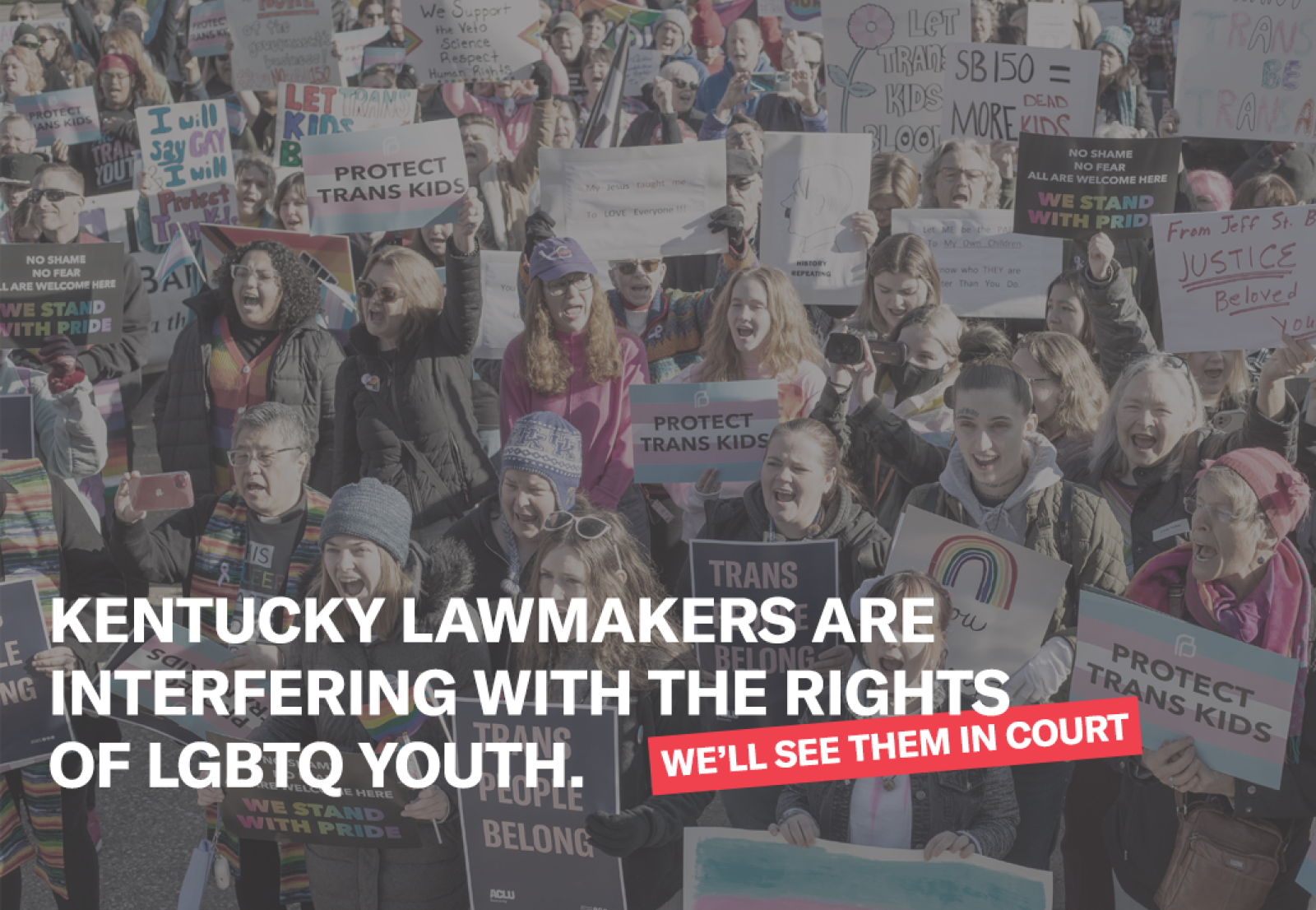
On January 5, Louisville Representative Mary Lou Marzian and three other Kentucky legislators (Reps. Flood, Jenkins and Palumbo) filed House Bill 117—a statewide Fairness law—that seeks to amend our state’s Civil Rights Act to include “sexual orientation” and “gender identity” as protected classifications, prohibiting discrimination against lesbian, gay, bisexual, and transgender Kentuckians in employment, housing, and public accommodations. Even today, any person suspected of being gay or transgender outside Lexington, Louisville, or Covington may be legally fired from their job, denied housing, or withheld access to any public accommodation—such as a bus ride or service in a restaurant.
On November 25 the Kentucky Supreme Court ruled that the
Commonwealth’s execution protocols were not legal.As a result, the Department of Corrections is rewriting the process by which we execute people and is currently
accepting comments on the proposed process.
The ACLU works to reform the
capital punishment process. In general, our Capital Punishment Project focuses
on improving the fairness of capital trials and appeals, improving the quality
of legal representation, and reducing the number of defendants who face the
death penalty.
Capital punishment is the
ultimate denial of civil liberties, and Kentucky’s proposed protocols only
compound that denial by violating many of the most fundamental constitutional
rights guaranteed to every American.
The Department of Corrections is required to review and
respond to all submitted comments, so please consider writing a letter or
attending the hearing. All written comments must be submitted my mail by
February 1st to Amy V. Barker and if you can testify in person at
the one-day hearing scheduled for 9 a.m. EST January 29 you must submit written
notification of your intent to do so to Ms. Barker by mail or fax by January
22.