Blocked by a Government Official on Social Media?
Last updated: May 8, 2026 02:33 pm
Elected representatives who use official government social media platforms to communicate with their constituents may block individuals from those platforms, but only in certain circumstances.
This is because the official social media pages for elected representatives and government organizations are public forums, and blocking members of the public from accessing these pages may be an unconstitutional restriction on your free speech rights.
How to use this toolkit:
The social media blocking toolkit is a self-advocacy tool that we hope will increase transparent and robust engagement between the public and elected officials in Kentucky.
Use the checklist below if you have been blocked from posting or commenting on an official government social media page operated by an elected representative or government organization.

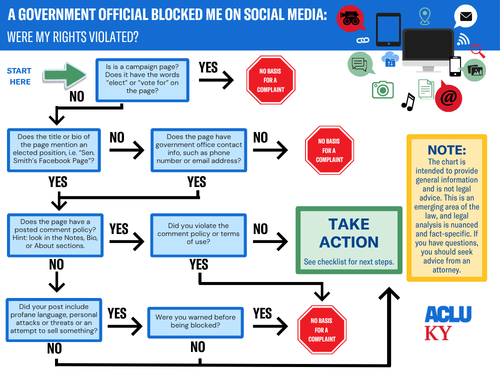
Step 1. Use the flowchart above to determine if you may have a claim.
Step 2. Document what happened (who blocked you, when they did so, on what platform/social media page, and why). Take pictures or screenshots.
Step 3. Contact the public official and ask to be unblocked. Document all communications.
Step 4. If you do not receive a response or if you remain blocked, download and personalize this letter and mail it to the public official.
Step 5. If it has been 30 days since you sent our sample letter and you still haven’t received a response, or if the public official refuses to unblock you or stop deleting your comments, fill out a legal intake form with the ACLU of Kentucky.
Related Issues
Stay Informed
Sign up to be the first to hear about how to take action.
By completing this form, I agree to receive occasional emails per the terms of the ACLU’s privacy statement.
By completing this form, I agree to receive occasional emails per the terms of the ACLU’s privacy statement.