
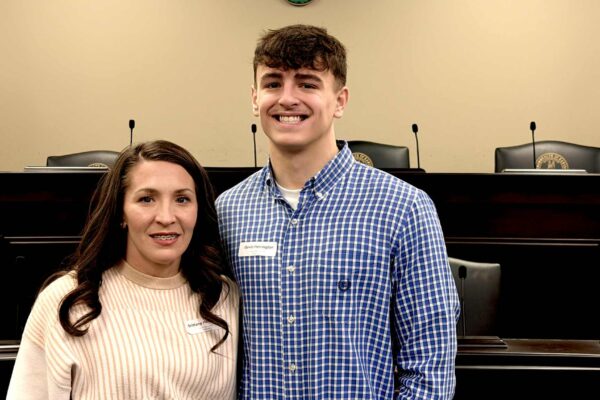
What I see clearly now is how hard it is for her to talk about it.
Every time my mom shares her story, I can see the pain return. The guilt of missing my early years hasn’t really left her. It hurts me to watch my mom relive the worst moments of her life. I can no longer sit quietly and watch her carry that weight alone. That’s not the man my family raised me to be.
When my mom was incarcerated, I went to live with my grandparents. My grandma had me say goodnight to my mom’s picture every night. I would run to our mailbox almost every day, hoping for a letter or a drawing. That was how I knew she was still there- somewhere. I knew that she had not disappeared.
Some of my earliest memories are visiting my mom while she was in treatment. I thought she was in a special school. I was always excited to see her. I did not understand why she could not come home. I just knew something was missing.
My mom was not a bad parent. She was sick.
She asked for help. She asked for treatment. Instead, she was jailed with no counseling or support. When she relapsed, she begged again and was sent to prison. That punishment did not just affect her. It affected me and our entire family.
Eventually, she did receive treatment. On my fourth birthday, she was paroled to a long-term program. She tells me I kept touching her face in the car, like I was trying to figure out if she was real. I do not remember that moment, but I believe it. I had already learned that parents can disappear.
That program changed her life. It came years too late.
Today, my mom is sober. I graduated as an honor roll student and an athlete. We are close. I am lucky.
But my story is not unique, especially in rural Kentucky. Across this state, kids grow up with parents cycling in and out of jail for low-level, nonviolent offenses tied to addiction. Grandparents step in. Families do their best while the system pulls them apart.
Kentucky has one of the highest rates in the nation of children with an incarcerated parent. Those are not statistics. Those are kids saying goodnight to pictures and running to mailboxes, hoping.
The Family Preservation and Accountability Act, which just passed the full Senate, offers a better way. It allows judges to consider community-based alternatives for primary caregivers, holding people accountable while keeping families connected and giving parents a real chance to recover.
When families stay connected, healing happens faster. For parents. And for kids.
I am here because my mom eventually got help. Other families deserve the same chance.
No child should lose a parent simply because that parent needs treatment.
Kentucky can choose a system that works. Lawmakers should pass the Family Preservation and Accountability Act.
Gavin Herrington is a Kentucky college student. His mother, Brittany, is a peer support specialist and advocate for people recovering from drug and alcohol addiction.